|

Blog Post Repurposing: One Article, Five Pieces

Here’s a scenario that probably feels familiar. You spend a couple of hours writing a solid blog post. You hit publish. You share it once on Facebook. And then it just… sits there. Meanwhile, you’re staring at a blank social media calendar wondering what to post next week. That right there is the core problem that blog post repurposing solves — and once you see how it works, you’ll never look at a finished article the same way again.

The goal here is simple. One blog post, written once, becomes five separate marketing pieces. No starting from scratch. No spinning your wheels. Just a smarter way to squeeze every drop of value out of the work you’ve already done.

Why Blog Post Repurposing Is the Smartest Move You’re Not Making

Most small business owners think of a blog post as a one-and-done thing. You write it, you publish it, maybe you share it, and then you move on. But that’s leaving a lot of value on the table.

Think about it this way. That post you just wrote? It contains a main idea, several supporting points, a handful of useful tips, and probably a story or two. Each of those pieces is content in its own right. Your audience on Instagram doesn’t necessarily read your blog. Your email subscribers might miss your social posts. The folks who found you through a Facebook group have never even heard of your website.

Repurposing isn’t recycling old garbage. It’s delivering genuinely useful content to different people through the channels they actually use.

And if you’ve been struggling to stay consistent — which, honestly, is the number one complaint I hear from small business owners — blog post repurposing is one of the most practical fixes there is. You can read more about why consistency is so hard to maintain in Why Your Business Blog Died (And How to Revive It). But the short version: you’re not lazy. You’re just trying to run an entire business by yourself. A system that multiplies your output without multiplying your effort? That’s worth paying attention to.

Start With a Blog Post Worth Repurposing

Before we get into the five pieces, let’s talk about the raw material. Not every blog post is equally easy to repurpose. The best candidates share a few traits.

They answer a real question your customers ask. They’re organized around clear, distinct points. They include at least one concrete tip, story, or example. And they’re long enough to have meat on the bones — somewhere between 800 and 2,000 words is a good sweet spot.

If you’re not sure what to write about in the first place, Blog Topics That Drive Business Results for Small Owners is a good place to start. And if time is your enemy, The 15-Minute Blog Post That Actually Works will show you how to get something solid written even on a busy day.

The point is: write the post first. Write it well enough that it genuinely helps someone. Then the repurposing becomes almost automatic.

The Five Pieces You Can Pull From Any Blog Post

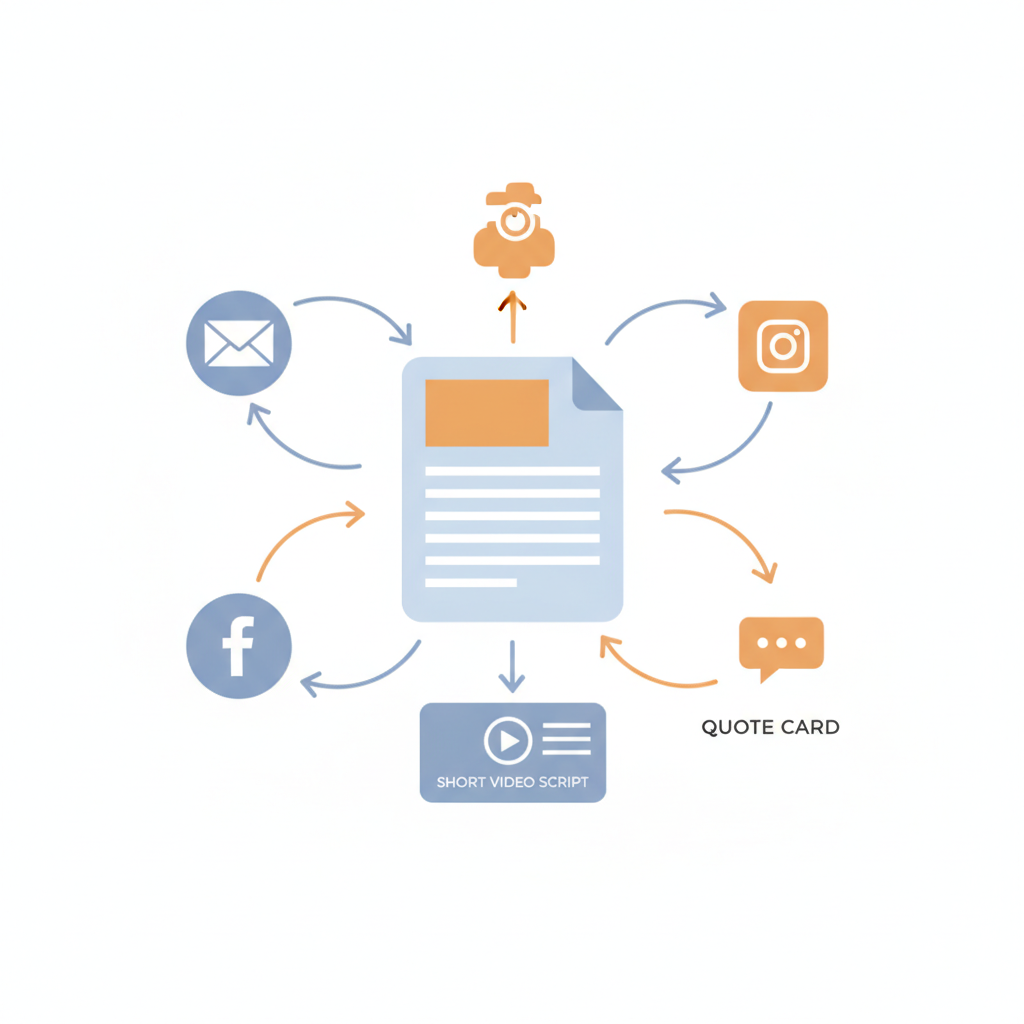
Here’s the system. Once your blog post is published, you’re going to pull five additional pieces from it. Each one is different enough to stand on its own, but all of them root back to the same original content.

Piece #1: The Email Newsletter

Your email list is the most valuable marketing asset you own. If you have one and you’re not sending regular emails, you’re leaving money on the table. And if you think you don’t have time to write both a blog post and an email, good news — you don’t have to.

Take your blog post and write a short email that teases the main idea. Two or three short paragraphs. Tell them what the post is about, share one quick insight from it, and then link to the full article. That’s it. You’re not rewriting the whole thing. You’re inviting people in.

If you want to go deeper on this, The Email List Strategy Hidden in Your Blog Posts lays out exactly how your blog and your email list can work together as a system.

The email doesn’t need to be long. It doesn’t need to be fancy. It just needs to feel like it came from a real person — because it did.

Piece #2: Three Social Media Posts

I’m counting this as one piece because the work is similar, but you’ll actually get multiple posts out of it. Go back through your blog post and find three distinct ideas, tips, or moments. Each one becomes a standalone social media post.

For a 1,200-word blog post organized around five tips, you’ve got at least five social post ideas sitting right there. Pick three of the strongest ones. Write a short caption for each. Add a relevant image or a simple graphic with the tip written on it. Done.

These posts don’t need to link to your blog. They can stand alone as useful content. Some of them might prompt someone to ask a question, which starts a conversation. Others might get shared, bringing new eyes to your business. Either way, you’re showing up on your audience’s feed with something worth reading — and you didn’t have to think it up from scratch.

Spread these three posts out over a couple of weeks. Suddenly one blog post has kept you active on social media for half a month. That’s the power of blog post repurposing done right.

Piece #3: A Pull Quote or Tip Graphic

Every well-written blog post has at least one sentence that lands just right. A line that makes you nod. Something quotable. Find it. That’s your graphic.

You don’t need a designer. Free tools like Canva make it easy to drop a quote onto a simple background with your business name or logo. Keep it clean. Keep it readable. Post it to Instagram, Facebook, Pinterest — wherever your people hang out.

This type of content performs well for a few reasons. It’s visually distinct from a wall of text. It’s easy to share. And it builds a sense of authority around your voice — that you’re someone with something useful to say.

The graphic can also work as a standalone post or as part of a series. If you’re posting consistently, a regular “tip of the week” format — sourced entirely from your existing blog posts — is a recognizable, low-effort presence builder.

Piece #4: A Short Video Script or Talking Points

Video feels scary to a lot of small business owners. But hear me out on this one. You don’t need a studio. You don’t need a ring light. You need a phone and thirty seconds of courage.

Take the main point of your blog post and turn it into a one-to-two minute talking-head video. You’re not reading the post out loud. You’re just talking about the idea like you would to a customer sitting across from you.

Use the intro of your blog post as your talking points. Cover the main problem it solves. Share one tip. Tell people where they can read the full thing. Post it to Facebook, Instagram Reels, YouTube Shorts, or TikTok — wherever your audience is.

Video is increasingly how people consume content. You’ve already done the thinking. You’ve already organized the ideas. Now you’re just saying them out loud with a camera rolling. If you’ve been creating content the hard way, check out Create More, Write Less for a mindset shift that makes this feel a lot more manageable.

Piece #5: A FAQ or Community Answer

This last one doesn’t get talked about enough. Your blog post, reduced to its core question and answer, becomes a ready-made response you can use in Facebook groups, Reddit threads, Nextdoor discussions, or anywhere your potential customers are asking questions online.

When someone in a local business group asks, “How do I get more customers to trust my website?” and you just wrote a post about that — you have a thoughtful, genuinely helpful answer ready to go. You’re not copying and pasting the whole article. You’re summarizing the key insight in three or four sentences and mentioning that you wrote about it in more detail if they want to dig in.

This works because it positions you as a helpful expert without feeling salesy. You’re not pitching. You’re answering. And people remember who gave them useful information when they needed it.

Putting the System Together

Let’s make this concrete. Here’s what your repurposing workflow looks like from start to finish.

Day 1: Write and publish your blog post. Share it once on your main social channel.

Day 2 or 3: Write your email newsletter teasing the post. Send it to your list.

Week 1 and 2: Schedule your three social media posts. Space them out.

Whenever you have 10 minutes: Make your pull quote graphic. Post it.

When the mood strikes: Record your short video. It can be messy. That’s fine.

Ongoing: Keep the post’s core idea in the back of your mind. When a relevant question comes up in a group or forum, drop in your answer and link if appropriate.

That’s one blog post turned into six distinct touchpoints with your audience — across email, social media, visual content, video, and community engagement. And the writing work happened only once.

If you’re not sure how to plan this kind of content calendar without it becoming a second full-time job, Content Planning for Real People With Real Lives is exactly the kind of grounded, practical guide you need.

A Few Things to Keep in Mind

You don’t have to do all five every time. Start with two. Email plus one social post. See how it feels. Add more as you get comfortable with the system.

Repurposing isn’t just for new posts. Go back through your archives. That post you wrote two years ago might be exactly what someone needs today. Pull it out. Update it if needed. Run it through this system fresh. Your content audit can help you find the posts worth bringing back to life.

Don’t overthink the format. The email doesn’t have to be beautiful. The graphic doesn’t have to be perfect. The video doesn’t have to be professional. The Case Against Perfect Blog Posts for Small Business makes the argument — pretty compellingly — that done beats perfect every single time.

Blog post repurposing works best when your original post is focused. One clear topic, one main idea, one audience problem being solved. That focus makes it easy to extract clean pieces. A sprawling post that tries to cover everything becomes hard to repurpose cleanly.

The Real Payoff Here

When you’re a small business owner, your time is the most valuable thing you have. Every hour you spend on marketing is an hour you’re not spending on the actual work of running your business — or being present with your family, or resting so you don’t burn out.

Blog post repurposing isn’t about doing more work. It’s about getting more out of the work you’ve already done. One well-written post, published consistently, and run through this simple five-piece system, is more marketing than most small businesses produce in a month.

And it’s sustainable. That matters more than people admit. A content strategy you can actually stick with — even when life gets busy, even when you’re tired, even when you missed last week — is worth ten times more than an ambitious plan you abandon by February.

Start small. Pick your next blog post. Commit to pulling just two pieces from it. Then see what happens. Chances are good you’ll wonder why you weren’t doing this all along.

Similar Posts

Leave a Reply

Your email address will not be published. Required fields are marked *