From Process to Playbook: Visualizing AI-Powered SMB Workflows for Quick Buy-In
Why visual AI workflows accelerate SMB buy-in
In SMB teams, ideas can stall at the door of complexity. Visualizing AI-powered SMB workflows turns abstract concepts into tangible, shareable roadmaps. By converting processes into a visual playbook, stakeholders can see value, dependencies, and risks at a glance, paving the way for fast approvals before Q2.
Visual storytelling translates data, tasks, and outcomes into a narrative leadership can grasp quickly. A diagram that shows owners, handoffs, data touchpoints, and AI touchpoints helps teams align on priorities, trade-offs, and governance-ready plans that move at the speed of business.
Framing the winter planning window
Winter planning is the optimal period to validate AI investments before the new fiscal year. The goal is to replace lengthy discussions with a compact, approval-friendly playbook that demonstrates impact within weeks. A visual, outcome-focused approach helps leaders understand risk, data needs, and the expected lift in efficiency or accuracy. Aim for a pilot launch in early Q1 with a clear Q2 milestone to rally around.
Anchor momentum around three questions: What problem are we solving? What does “done” look like? How will we measure success? Answering these with visuals keeps the plan focused on value delivery rather than theoretical potential.
Mapping current workflows into visual representations
Capture current-state processes and render them as visual workflows to reveal gaps, bottlenecks, and data dependencies. Use simple diagrams non-technical stakeholders can read at a glance. Common formats include flowcharts, swimlane diagrams, and value-stream maps showing who does what, when, and with which data.
Practical steps to map effectively:
- Assemble a cross-functional mapping session with owners from operations, finance, sales, and IT (as relevant).
- Document the current steps, decision gates, and data inputs/outputs for each process.
- Annotate pain points, manual handoffs, and error-prone steps.
- Highlight data privacy, security, and governance concerns at each touchpoint.
- Transform the map into a visual “as-is” diagram set that’s easy to share in leadership reviews.
With the as-is maps in hand, you’ll illustrate how AI can streamline steps, automate routine decisions, and improve outcomes without overhauling the entire system. The emphasis is on clarity and speed of comprehension—the core of AI-powered SMB workflows that teams can rally around quickly.
Identifying high-impact AI opportunities
Not every process benefits equally from AI. The aim is to surface opportunities that deliver meaningful lift with manageable risk and data requirements. Use a simple scoring framework to prioritize candidates for the pilot queue.
- Impact: Which step most affects customer outcomes, time-to-value, or cost reduction?
- Feasibility: Is data available, clean, and accessible? Can you deploy with existing tools?
- Speed to value: How quickly can we show measurable improvement?
- Compliance and governance: Are there privacy, security, or policy concerns?
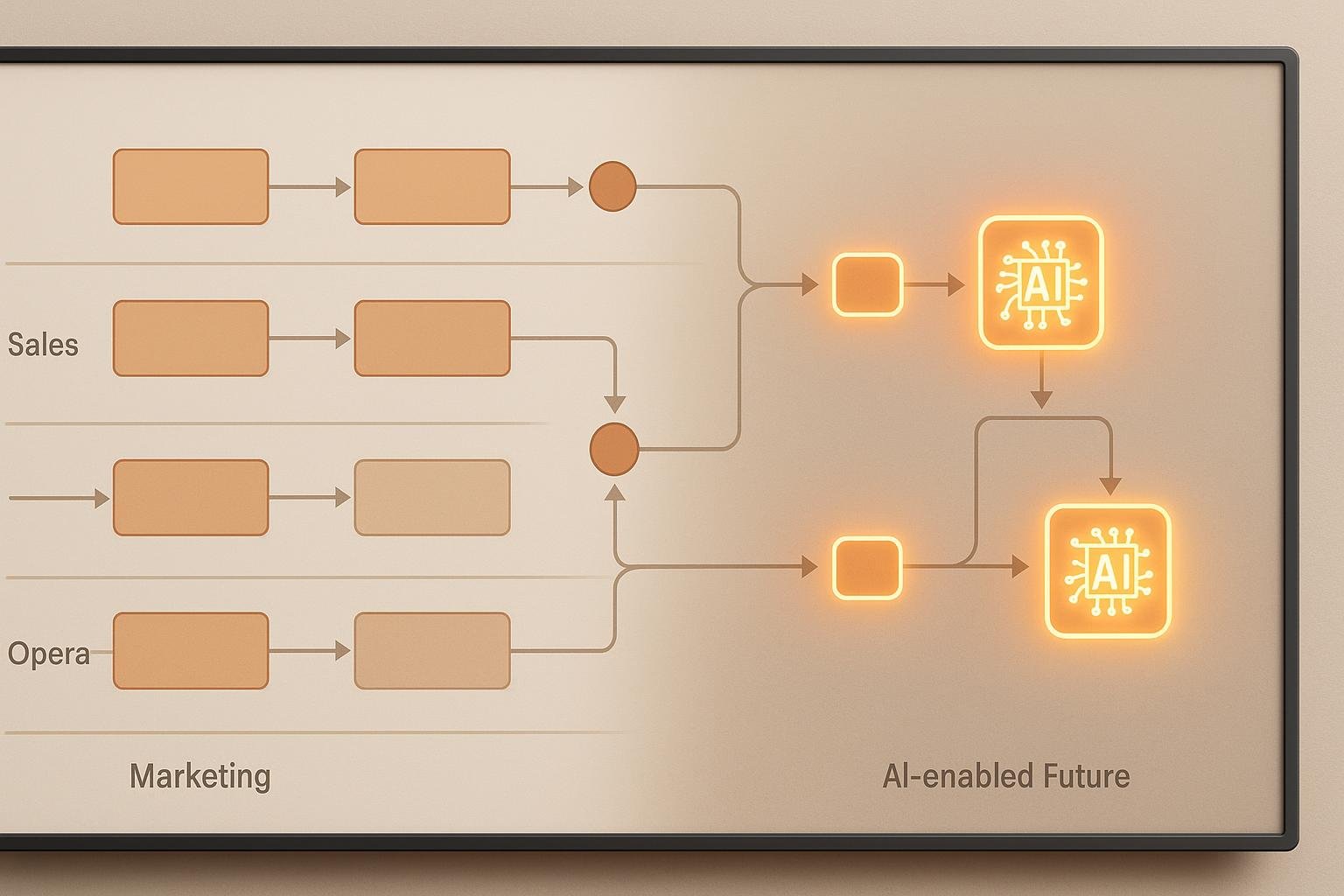
Common early opportunities include automating repetitive data entry, accelerating document processing (invoices, orders, contracts), AI-assisted customer support, demand forecasting, and scheduling or routing optimization. Start with 1–2 high-impact candidates with clear owners and success criteria. Visualize these opportunities as future-state boxes connected to the current-state map, highlighting the delta in time, cost, and accuracy.
Defining success metrics for quick buy-in
Clear metrics enable fast governance approvals. Define leading and lagging indicators with targets that are ambitious yet achievable within a short pilot window. Prioritize metrics stakeholders can influence and that demonstrate tangible value.
- Time-to-value: reduction in process cycle time.
- Efficiency gains: minutes saved per transaction or reduced manual steps.
- Quality and accuracy: improved error rates or reduced rework.
- Adoption and engagement: user participation rates and satisfaction.
- Cost impact: measurable changes in operating costs.
- Risk and governance: adherence to data policies and auditability of decisions.
Attach a simple KPI summary to each AI opportunity in the playbook: baseline, target, data requirements, and owners. When leadership can see projected lift alongside a realistic risk view, quick buy-in becomes practical rather than aspirational.
Ready-to-use playbook template
Use this compact template to convert mapped workflows and AI opportunities into a formal playbook you can present in a single governance session. Design for speed and clarity, not bureaucracy.
- Executive summary: 2–3 sentences on objective and impact.
- Current-state visuals: one or two process maps showing baseline steps and pain points.
- Future-state overview: the AI-enabled workflow with key changes and touchpoints.
- Data and tools inventory: data sources, quality notes, required integrations, and tools.
- AI opportunity backlog: prioritized pairings of owners, success criteria, and pilot scope.
- Roles and governance: decision makers, data stewards, security owners, escalation paths.
- KPIs and targets: baseline and goal metrics with data sources.
- Pilot plan and milestones: scope, timeline, resources, go/no-go criteria.
- Risks and mitigations: privacy, compliance, reliability, and change management considerations.
- Communication plan: visuals for stakeholders, update cadence, and approval checkpoints.
Fill the template with winter planning outputs: the as-is maps, AI-enabled future-state diagrams, and pilot scope. The visual playbook becomes the single source of truth that teams, leadership, and partners can rally around and review quickly.
A fast pilot plan to de-risk adoption
Execute a fast, well-scoped pilot to reduce risk and build momentum. Target a 4–6 week horizon with a measurable endpoint. Select 1–2 high-impact workflows that are representative yet manageable, and define success criteria up front.
- Scope: narrow enough to complete within 4–6 weeks; include end-to-end steps and at least one AI touchpoint.
- Owners and accountability: assign a pilot lead and a data steward; define go/no-go decision rights.
- Data readiness: confirm data availability and quality; establish data-handling controls.
- Technology and integration: confirm required tools and APIs; keep integrations minimal and auditable.
- Milestones and reviews: weekly progress demos and blockers; final leadership demo.
- Success criteria: concrete metrics tied to KPIs; include a go/no-go decision point.
Document results in the playbook visuals so stakeholders can see the actions taken and outcomes achieved. If the pilot delivers value, scale AI-powered SMB workflows incrementally across other processes or functions.
Visual storytelling, governance, and practical next steps
Visual storytelling is more than attractive diagrams—it’s a communications strategy that aligns teams and accelerates decisions. Use consistent visuals to show current and future states, risk heat maps, and ROI projections. Keep visuals simple enough to share in leadership meetings and cross-functional updates, so stakeholders can act on a clear narrative.
Governance is the backbone that keeps the initiative aligned with policy, security, and performance standards. Establish a lightweight steering committee, assign data ownership, and define escalation paths. Document roles, decision authorities, and review cadences to reduce friction and enable responsible AI experimentation for SMB workflows.
Next steps you can take today:
- Finalize the winter planning playbook draft and circulate for quick feedback.
- Lock in 1–2 pilot opportunities with clear success criteria and owners.
- Prepare a short leadership demo contrasting current-state visuals with AI-enabled outcomes.
- Publish a light governance plan and a data-handling policy to address privacy and compliance concerns.
- Schedule the pilot kickoff and establish a weekly update rhythm; aim to start within 2–3 weeks.
By converting processes into a visual, AI-powered SMB workflows playbook during winter planning, teams create a shared, actionable blueprint. The plan reduces ambiguity, speeds up approvals, and provides a concrete path to Q2 milestones. It’s not just a concept—it’s a practical, governance-friendly approach that turns ideas into experiments, experiments into pilots, and pilots into scalable operations.