ROI-First AI for SMBs
Budgeting, Justification, and Quick Wins with NuTekAI
Adopting AI in a small business isn’t just about adopting the newest tech. It’s about delivering measurable value, quickly and consistently. An ROI-first mindset helps you prioritize projects that pay for themselves, stay within cash flow constraints, and expand only after you’ve validated the impact. In this guide, you’ll find a simple budgeting framework, a quick-start playbook, and real-world NuTekAI outcomes that illustrate what ROI looks like when you move from theory to practice.
Why an ROI-first mindset matters for SMBs
Small teams move fast, but budgets are tight. An ROI-first approach helps you avoid big bets on technology that doesn’t pay for itself. Start with the obvious bottlenecks—areas where a little automation saves substantial time or where data quality directly affects revenue. For many SMBs, that means starting with tasks that happen every day and are repeatable. If you’re unsure where to begin, a low-code AI pathway can prove value with minimal setup.
Simple budgeting framework for AI adoption
Use a lightweight, three-part frame to decide what to automate and when to scale:
- Define outcomes: pick 1–2 measurable results (time saved, error reduction, or revenue impact).
- Estimate costs: include software, integration, and a modest amount of internal time for setup and governance.
- Forecast benefits: quantify time saved, fewer errors, and any revenue uplifts. Use rough numbers for the first pass, then tighten as you run pilots.
To ground this in reality, here are two simple scenarios SMBs can consider as starting points. In both, you’re comparing a one-year cost against estimated annual benefits to compute a simple ROI.
- Lead intake automation: saves 6 hours per week at $25/hour. Annual benefit ≈ $7,800. Estimated annual costs (license + setup) ≈ $2,000. ROI ≈ (7,800 − 2,000) / 2,000 ≈ 290%.
- Invoicing automation: saves 8 hours per week at $25/hour. Annual benefit ≈ $10,400. Annual costs ≈ $3,000. ROI ≈ (10,400 − 3,000) / 3,000 ≈ 247%.
ROI isn’t just about dollars saved; it also captures faster cycles, happier customers, and easier compliance. After you run a 4–8 week pilot, you’ll have numbers you can share with stakeholders and use to decide whether to expand the initiative.
Quick-start playbook for fast wins
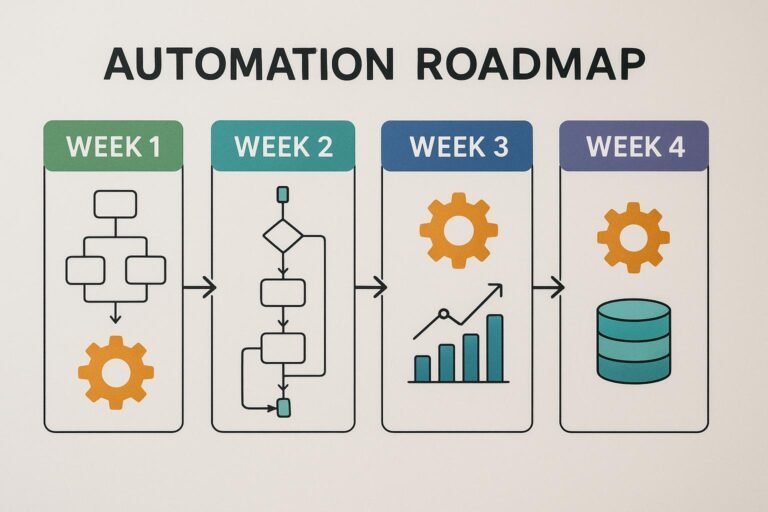
Follow a pragmatic, four-step approach to land one or two early wins without derailing your operations.
- Step 1 — pick a target process: choose a single, repeatable task with clear ROI potential. A common starting point is AI lead intake and scheduling for service teams, which streamlines booking and reduces back-and-forth.
- Step 2 — run a lightweight pilot: use a low-code AI approach to validate the concept with minimal setup time and cost. Keep scope small (one channel, one outcome).
- Step 3 — measure and learn: track the actual time saved, conversion rates, and customer satisfaction. Compare results against your baseline, and use a simple ROI calculation to judge success.
- Step 4 — decide on scale: if ROI thresholds are met, extend the rollout to adjacent processes or teams in 90 days or less, with a plan to monitor ongoing value.
Real SMBs range from solo freelancers to small teams in professional services. In many cases, a 4–6 week pilot demonstrates that AI can reclaim hours each week and reduce the friction that slows growth.
NuTekAI case studies: real-world outcomes
Across our client base, ROI-first AI pilots have unlocked faster cycles, fewer manual errors, and higher capacity for service delivery. A few representative examples show what’s possible when you start with value and then scale responsibly.
For example, invoice automation with AI dramatically cut processing time and reduced late payments, translating to measurable cash flow improvements for a small business.
Another example focused on AI proposal automation for agencies and consultants. By automating draft proposals and standard responses, teams cut proposal cycles and increased win rates, delivering tangible ROI in weeks rather than months.
There are many paths to ROI, including automating AI lead intake and scheduling for more consistent inquiries and faster responses across channels. These patterns show up repeatedly across industries and team sizes, from solo practitioners to small agencies.